







Advancing the Science and Technology of Materials, Interfaces, and Processing
The American Vacuum Society (AVS) Prairie Chapter is a non-profit, volunteer-based organization dedicated to advancing the science and technology of vacuum, materials, surfaces, interfaces, thin films, and plasmas. The AVS promotes communication, dissemination of knowledge, recommended practices, research, and education in the use of vacuum and other controlled environments to develop new materials, process technology, devices, and related understanding of material properties for the betterment of humanity.
The AVS is comprised of approximately 4,500 members worldwide. It is organized into: Technical Divisions & Groups, Regional & Student Chapters, and International Affiliates.
The Prairie Chapter covers Illinois, Indiana, Iowa, Missouri, and eastern Wisconsin. We serve members and their community through:
- Meetings & symposia
- Invited speakers
- Short courses
- Educational outreach
- Equipment exhibits
- Student awards
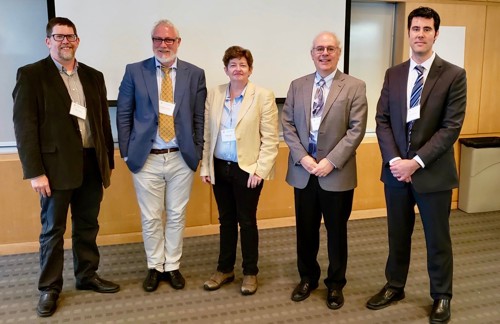
2018 AVS Prairie Chapter Symposium - Invited speakers and organizers
(L to R): Dan Killelea (Loyola, Chapter chair), Thomas Orlando (GA Tech), Melissa Hines (Cornell), Steven Sibener (UChicago, meeting chair), David Flaherty (UIUC, Early Career Awardee)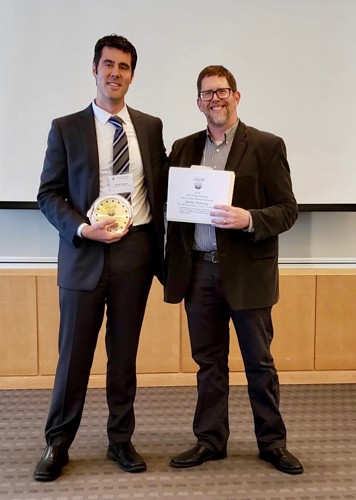
2018 AVS Prairie Chapter Early Career Research Awardee David Flaherty (left, UIUC).
Prof. Flaherty received the ‘heaviest award in science’ from the AVS Prairie chapter.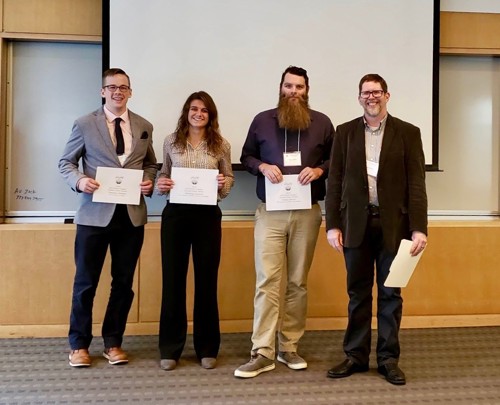
2018 AVS Prairie Chapter Student Poster Award Winners.
(L to R) Tim Grabnic (UChicago), Brittney Gorman (UIUC), and Tobias Morris (Indiana) with chapter chair, Dan Killelea
Officers
Chair
Nan Jiang
E-mail: nan_jiang @ avs.org
Vice-Chair
Weronika Walkosz
E-mail: weronika_walkosz @ avs.org
Treasurer
Julio Soares
E-mail: julio_soares @ avs.org
Secretary
Dan Killelea
E-mail: dan_killelea @ avs.org
Past Chair
Jessica McChesney
E-mail: jessica_mcchesney @ avs.org
Members-at-Large (two-year term)
Yip-Wah Chung - Northwestern University
E-mail: yip-wah_chung @ avs.org
Bob Campbell
E-mail: bob_campbell @ avs.org
Scott Dix - Vacuum One
E-mail: scott_dix @ avs.org
Matthew Gebbie - University of Wisconsin-Madison
E-mail: matthew_gebbie @ avs.org
Sean L. Jones - Argonne National Laboratory
E-mail: sean_jones @ avs.org
Mary Kraft - University of Illinois, Urbana-Champaign
E-mail: mary_kraft @ avs.org
R. Mohan Sankaran - University of Illinois at Urbana-Champaign
E-mail: mohan_sankaran @ avs.org
Steven J. Sibener - University of Chicago
E-mail: steven_sibener @ avs.org
Jeff Terry - Illinois Institute of Technology
E-mail: jeff_terry @ avs.org
Michael Trenary - University of Illinois Chicago
E-mail:michael_trenary @ avs.org
Matthias J. Young - University of Missouri
E-mail: matthias_young @ avs.org
Date: September 1, 2022
AVS Prairie Chapter Annual Symposium 2022
The 2022 AVS Prairie Chapter Fall Symposium will be held on September 1, 2022 at the University of Notre Dame in Notre Dame, Indiana. This will be an in-person event and will consist of invited and contributed presentations, a poster session including a student poster competition and an equipment exhibit for vendors to display surface analytical, vacuum, microscopy, thin film, and microelectronic equipment.
Date: Wednesday, March 31, 2021 | 4 pm (Central), 5 pm (EDT)
Speaker: Julie G. Ezold, Oak Ridge National Laboratory
Title: Heavy Actinide Production Program at Oak Ridge National Laboratory
Virtual Student Chapter Meeting of the AVS Prairie Chapter
For more than 50 years, Oak Ridge National Laboratory’s (ORNL) unique research facilities and staff have provided the research community with heavy actinides through fermium (257Fm). ORNL’s facilities, the Radiochemical Engineering Development Center and the High Flux Isotope Reactor, are truly one-of-a-kind for the production of heavy actinides. All aspects of the reactor-produced heavy actinides will be addressed: fabrication of curium targets, irradiation, radiochemical separations and purification processing. Research activities for new production and separations techniques are being pursued at ORNL and will include novel irradiation schemes and shielding materials for berkelium and einsteinium production. To improve separations, replacement of the CLEANEX (HDEHP extraction) and the LiCl anion exchange processes are being investigated. Another focus area is the separation of americium from curium to enhance the quality of the current feedstocks for heavy actinide production.
Date: Wednesday, October 28, 2020 | 4 pm (Central), 5 pm (Eastern)
Speaker: Dr. Scott Chambers, Pacific Northwest National Laboratory
Title: X-ray photoelectron spectroscopy - a rich source of more than just chemical information
X-ray photoelectron spectroscopy (XPS) was first discovered in 1907 following Einstein’s explanation of the photoelectric effect. Over the years, XPS has became a tool of widespread utility in surface analysis, physical chemistry, materials science and condensed matter physics. The physics of XPS is rather complex.1 There are several physical drivers that determine what the spectra look like. However, as the popularity of XPS has expanded in the world of surface analysis, common understanding of the technique has been reduced to the point that most practitioners are only aware of XPS yielding information on elemental abundances and chemical states of atoms. As a result, the richness of physical insight into the electronic properties of materials has been largely lost and a multitude of misinterpretations of spectra have been reported in the literature. In this talk, I will first give an overview of the five primary physical effects that determine XPS binding energies and line shapes. I will then present a recent case study in which XPS provides an accurate, detailed explanation of a completely unexpected result in the world of oxide/semiconductor interface physics, namely the observation of a two-dimensional hole gas at the epitaxial interface of n-SrNbxTi1-xO3 and undoped Si(001) prepared by molecular beam epitaxy.2-4
Date: Monday, September 14, 2020 (online) | 1-5 pm (Central), 2-6 pm (Eastern)
AVS Prairie Chapter Annual Symposium 2020 (VIRTUAL/ONLINE)
The AVS Prairie Chapter Annual Symposium 2020 will be an online meeting featuring talks by our award winners, Nan Jiang and Luke Hanley, and an online poster session. We encourage broad participation in the poster session, especially from students and postdocs, to gain experience in communicating science and networking using online forms of communication. Undergraduate and graduate researchers are eligible for awards in the poster competition. Please indicate your willingness to enter your poster for judging.
Online session (times listed here are Central time)
1:00 pm Welcome
1:10 pm Prof. Nan Jiang, Dept. of Chemistry, Univ. of Illinois at Chicago
AVS Prairie 2020 Early Career Award
1:40 pm Prof. Luke Hanley, Dept. of Chemistry, Univ. of Illinois at Chicago
AVS Prairie 2020 Research Award
2:10 pm Preview of posters (pre-recorded videos)
2:30 pm Online poster session on Twitter
5:00 pm Poster awards announcements
Date: August 26, 2020 (5 P.M. EDT)
Speaker: Prof. Ashleigh Baber (James Madison University)
Title: Controlling selectivity by modifying model catalyst surfaces
Through the use of temperature programmed desorption, we have studied how molecules influence surfaces, how molecules interact with each other on surfaces, and how surfaces influence molecules. The first part of the talk will highlight the low temperature exchange of hydrogen and deuterium through molecularly-adsorbed species on an inert gold substrate (Au(111)). Exchange beyond the acidic hydrogen in ethanol was not observed, and therefore is expected to occur via a Grotthuss-like mechanism, which relies on the presence of hydrogen-bonded molecular networks. This phenomenon was surprising to see on Au(111), which acts only as a support for the networks to form. In the second part of the talk, the role of modifications on Au(111) to enact chemical reactivity will be explored. Titania nanoparticles dispersed on Au(111) provide active sites for both the oxidation of ethanol to acetaldehyde and the elimination to form ethylene. Through careful control of the surface preparation procedures, the reaction can be driven towards the selective oxidation of ethanol to form acetaldehyde. In both projects discussed, we use surface science to gain insight into the fundamental interactions between molecules on surfaces and molecules with surfaces.
Date: June 24, 2020 (5 P.M. EDT)
Speaker: Prof. Sally McArthur from Swinburne University of Technology
Title: Four ToF-SSIMS Instruments and a QCM-D – Adventures in Biointerface Engineering from Down Under
Control and the ability to elicit specific responses from a biological system lies at the heart of most bioengineering. We want to immobilize proteins on biosensors but ask them to as sensitive as they are in solution or in the body, stimulate cells to assemble into tissues, reconstructing our bodily functions. We want methods that prevent bacteria forming biofilms and better still we would like them to stop bacteria attaching to surfaces full stop.
But biology is soft and normally has lots of water associated with it, so how and why would you want to use vacuum based techniques to create coatings or characterise these systems? This talk will explore how in my group and our collaborators, have tackled the challenges associated with interfacing vacuum deposited plasma polymers with water, proteins, lipids and cells to create a wide number of model systems and devices. At the same time, we have developed methods for chemically characterising these systems in vacuum, integrating XPS and ToF-SIMS with a range of other surface analytical and biological tools to gain insight into the materials we create and their interactions with biological systems.
Date: May 27, 2020 (5 P.M. EDT)
Speaker: Prof. James Whitten (UMass Lowell)
Title: Surface Chemistry of Zinc Oxide Nanoparticles: Optochemical Sensing and Photocatalysis
Zinc oxide nanoparticles have a wide range of applications that include catalysis and optoelectronics. ZnO is unique in that its surface is fairly reactive with respect to gas adsorption, and it has a bimodal room temperature photoluminescence (PL) spectrum consisting of UV excitonic and surface defect-related visible emission peaks. The surface chemistry of a variety of adsorbates on ZnO nanoparticles and single crystal surfaces will be discussed. Adsorbates studied include water, sulfur dioxide, nitrogen dioxide, methanol and methanethiol. It is found that chemisorption has a dramatic effect on the PL spectrum of ZnO, and this may be used to accomplish so-called “optochemical sensing”. Experimental surface science studies, including X-ray photoelectron spectroscopy measurements, have been accompanied by density functional theory (DFT) calculations to understand the surface chemistry that occurs and to correlate it with observed PL changes. Adsorbed hydroxyl groups, which act as charge traps and may be replaced by chemisorption of molecules such as sulfur dioxide and methanethiol, are found to play a key role in the PL changes. A portable UV LED, two wavelength flurometer optimized for monitoring PL changes of metal oxide nanoparticles has also been constructed, and its applications have been demonstrated. The surface chemistry of zinc oxide and its affinity for chemisorption of thiols has also been exploited to attach gold nanoparticles (AuNPs) to ZnO nanorods using dithiol linkers. The AuNPs enhance the photocatalytic activity of ZnO nanorods by reducing the recombination rate of electron-hole pairs. The photocatalytic properties of these composite materials are discussed.
April 29, 2020 - Virtual Student Chapter Meeting
Speaker: Prof. Gerald Seidler
Title: Core Level Spectroscopy
Core-shell spectroscopies such as x-ray photoelectron spectroscopy (XPS), electron energy loss spectroscopy (EELS), x-ray absorption fine structure (XAFS) and x-ray emission spectroscopy (XES) play a major role in vacuum and nonvacuum characterization of materials spanning contemporary research and industrial product development while also having some footprint in environmental safety and regulatory compliance. XPS and EELS have long been available in the lab for routine application, but the same is not true of XAFS and XES which have instead been almost exclusively been available at synchrotron x-ray facilities. In this talk, I will describe my group’s work that has helped lead to the ongoing renaissance of lab-based XAFS and XES using only conventional x-ray tubes. After giving an overview of the fundamentals of core-shell spectroscopies and summarizing the technology that we have developed at the University of Washington, I will present many applications that share a common characteristic: progress requires iterated rapid feedback in exactly the common meaning of the term “routine analytical chemistry”. To be specific, the term "routine' requires first that the technique would have very high availability and second that interpretations should be accessible to, for example, chemists,chemical engineers, and materials scientists who have had usual undergraduate coursework and training. While such measurements are obviously technically feasible at synchrotron light sources, they are a poor fit with both the facility mission and its access model. Examples will include in situ XANES studies of pouch cell batteries under fast charging conditions, nanophase identification, comparison of XPS and XANES to determine differences in surface and bulk oxidation states in metal-oxide supercapacitor electrodes, phosphorus XES of quantum dots for next-generation QD-LEDs, and the analysis of hexavalent Cr faction in plastics to address regulatory safety.
Sponsorship of local school teachers to attend Science Educator's Workshop at the National AVS meeting
Each year, the Prairie Chapter searches for local schoolteachers interested in continuing education opportunities by attending the Science Educator’s Workshop at the national AVS meeting, a two-day in-service workshop on low-pressure experiments and modeling for high school science teachers. All travel and registration expenses are covered for the teacher by the Prairie Chapter of the AVS. This program serves as a pathway for the teacher to absorb the latest science and technology the AVS has to offer and to bring this information back to the classroom to educate the next generation of potential AVS members. Benefits include continuing education credits, a vacuum system identical to the one used at the SEW, workbooks, and experiments to be performed by students using the vacuum system.
In order to apply to attend the SEW, please complete the Science Educator’s Application Form, which can also be found on the Science Educators Workshop page.
Here are some comments from Monica Gomez (Chicago Public Schools, Chicago, IL), who attended the 2017 AVS Science Educator’s Workshop in Tampa, Florida:
I loved the SEW conference in Tampa, Fl. I was able not only to grow as a teacher but as a student as well. The experiences were very diverse (People from around the U.S.A) and valuable (Professors from different Universities). Most importantly, I was able to transfer that knowledge to my Advanced Chemistry Senior Class last year. The students were impressed that something "so small" could serve as a model for the conditions of Outer Space. The students enjoyed the challenges they faced with the analytic mathematical portion of the Demos they themselves ran. We researched some aspects of Vacuum Technologies and they were blown away that they were used in everyday things. They were especially interested in how it was applicable to computers and in the fields of Medicine and Bioengineering.
Here are some comments from Monica Owens (La Porte High School. La Porte, IN), who attended the 2015 AVS National Meeting in San Jose, CA:
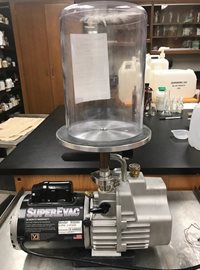 Vacuum bell jar used for science demonstrations. This set up recreates the ‘Galileo experiment’; where a feather and paper clip are held on the top of the jar to demonstrate all objects fall at same rate in absence of air resistance. |
"I have used the vacuum system in a variety of lessons in my class including pressure, thermodynamics, sound waves, and mechanics. I have also been sharing the system with my department, with about 4 other teachers using it a handful of times each. We had a very old, unreliable system before this and struggled to do the demos that really bring these topics home to students. With our new system, we can renew our emphasis on demonstrations like these. I am very grateful that I was able to get such a great vacuum system for my classroom, really my entire department. The AVS conference was also very impressive. Since state funding has been significantly reduced for professional development, attending scientific conferences is no longer an option. The conference reminded me of the skills my students need to be successful in scientific fields of study. I was inspired to challenge my students more and integrate current scientific research into my course work more often. I can't thank your chapter enough for sending me. The lasting impact of the workshop was a renewed vision of science education and a motivation to continue to provide engaging lessons for my students." |
Additional comments from Tina Lulla (Evanston Township HS, Evasnton, IL), who attended the 2016 AVS National Meeting in Nashville, TN:
"The workshop was awesome for me. I loved the way we got to work with the exact vacuum pump system that we would be getting and that we got to try out some of the activities provided."
Student Awards
At the annual AVS Prairie Chapter symposium, three students are awarded ‘best poster’ prizes by a panel of judges. Recent winners are:
2017:
Duygu Gerceker (UWisconsin), Angela Silski (ND), Darren Veit (UChicago)
2016 (IIT):
Ross Edel (UChicago), Fatemeh Ostadhossein (UIUC), Chris Williams (Indiana)
2015 (Notre Dame):
Xueqiang Zhang (ND), Brandon Hirsch (Indiana), Rachael Farber (Loyola)
2014 (Loyola):
Jonathan Raybin (UChicago), Martin McBriarty (NU), Yuan Ren (UIC)
2013 (UIC):
Zach Hund (UChicago), Zhu Liang (UIC), Jorge Rossero (UIC), Yuan Ren (UIC)
2012 (UIUC):
Yi Chen (UIUC), Hefei Hu (UIUC), Zhu Liang (UIC)
2011 (Northwestern):
L. Gaby Avila-Bront (UChicago), Jaemyung Kim (NU), Justice Alaboson (NU)
| Year | Location | Award Recipients |
| 2025 | UW-Madison |
|
| 2024 | UIUC, IL |
|
| 2023 | IIT, IL |
|
| 2022 | Notre Dame, IN |
|
| 2021 | Virtual |
|
| 2020 | Virtual |
|
| 2019 | Urbana, IL |
|
| 2018 | Chicago, IL |
|
| 2017 | Milwaukee, WI |
|
| 2016 | IIT |
|
| 2015 | Notre Dame |
|
| 2014 | Loyola |
|
| 2013 | UIC |
|
| 2012 | UIUC |
|
| 2011 | Northwestern |
|
| Year | |||
| 2021 | Fereshteh Rezvani | Robert Bavisotto and Brittney Gorman | Ayanna Culmer-Gilbert |
| 2020 | David Turner | Melanie Brunet | David Wisman |
| 2019 | Andrea Perry | Prapti Kafle | Haw-Wen Hsiao |
| 2018 | Brittney Gorman | Tim Grabnic | Tobias Morris |
| 2017 | Duygu Gerceker | Angela Silski | Darren Veit |
| 2016 | Ross Edel | Fatemeh Ostadhossein | Chris Williams |
| 2015 | Xueqiang Zhang | Brandon Hirsch | Rachel Farber |
| 2014 | Jonathan Raybin | Martin McBriarty and Yuan Ren | |
| 2013 | Zack Hund | Zhu Liang | Jorge Rossero and Yuan Ren |
| 2012 | Yi Chen | Hefei Hu | Zhu Liang |
| 2011 | L. Gaby Avila-Brout | Jaemyung Kim | Justice Alaboson |
| 2010 | No award recipients | ||
| 2009 | No award recipients | ||
| 2008 | Aashani Tille Karatue | David Corustock | Paul Desario |
| 2007 | No award recipients | ||
| 2006 | Abhichek Agraval | Christina Freyman | Benjamin Ohio |
| 2005 | Michael Arnald and Natalia Yufa | Allen Hall | Yu Yang and Srenivar Jayaraman |
| 2004 | G.J.Xu | Kenji Ohmori | Chang-Soo Lee |
Purpose: To encourage and support graduate students to present their work at the annual AVS symposium.
Nature: The Prairie Chapter will pay the registration fee for a limited number of graduate students to present either a poster or oral presentation of their research at the AVS symposium. The Chapter cannot cover travel or any other costs associated with the students’ attendance at the meeting.
Eligibility: The graduate student and their advisor must be members of the Prairie Chapter and must have an abstract accepted for presentation at the meeting. Currently, postdoctoral associates and undergraduate students are not eligible.
Deadline: August 15th. However, as only a limited number of waivers will be available, and as they will be awarded on a first-come first-served basis, applicants are encouraged to apply soon after they receive notification that their abstract has been accepted.
Nominating procedure: To apply for a waiver the student should submit the following by August 15th to the Chapter Secretary (Jessica McChesney, jmcchesn@anl.gov):
- A copy of the accepted abstract indicating that the student is the presenting author.
- A brief statement from the student’s research advisor (who must also be a member of the Chapter) stating that the student is actively working towards a graduate degree under the advisor’s direction. This can be either in the form of an email note or a signed letter on university letter head.
- A completed meeting registration form (PDF file). The payment information on the form should be left blank.
The applications will be evaluated by the review committee in the order received and awards made until the available funds are spent. The committee will verify the student’s and their advisor’s membership in the Prairie Chapter. Please note that these registration awards along with payment will be sent to the National AVS office on behalf of the students and that the Chapter cannot reimburse students for the cost of registration if they register and pay online on their own. It is anticipated that approximately ten waivers will be awarded per year.
Purpose: To encourage and reward outstanding research in materials, interfaces, or processing.
Nature: The award consists of $1,000, a certificate setting forth the reasons for the award, and an honorary lectureship at the annual Prairie Chapter meeting.
Eligibility: A nominee must have accomplished outstanding research of a theoretical or experimental nature in a field related to materials, interfaces, or processing. The nominee must have been a member of the AVS for a minimum of five continuous years at the time of nomination and must be a current member of the Prairie Chapter. Special consideration will be given to nominees who have demonstrated a commitment to the AVS through sustained service. Current members of the Prairie Chapter Executive Committee are not eligible.
Deadline: April 30, 2026
Support: The award is sponsored by the AVS Prairie Chapter.
Nomination procedure:
Complete package should be transmitted electronically as a single PDF file to: Jessica McChesney, AVS Prairie Chapter Awards Committee Chair, jmcchesn@anl.gov. Receipt will be confirmed by email.
A nomination may be made by anyone qualified to evaluate, highlight, and validate the nominee’s accomplishments. An individual may submit only one nomination letter in any given year. The nomination package must include the following:
Nomination Letter - The letter nominating an individual must describe the work for which the award is proposed and indicate the role the work has played in solving particular scientific or technological problems. The significance of these problems and the impact of the nominee’s accomplishments on the field should be discussed. If the work was performed in collaboration with others, the contributions of the nominee should be clearly stated. A proposed citation, a one-sentence synopsis of the reason for selecting the nominee, and a list of individuals sending supporting letters, should also be included. The nominating letter should not exceed two pages in length, but should be as detailed as possible to allow the Awards Committee, who may be experts in other fields, to evaluate the nominee’s contributions.
Biographical Materials - A Curriculum Vitae or biographical sketch of the nominee, including a list of publications and patents must be provided.
Supporting Letters - A maximum of two supporting letters must be arranged by the nominator. Typically these should not exceed one page. Their main purpose is to endorse the nomination and to provide additional evidence of the nominee’s accomplishments. The supporting letter(s) should be written by individuals at institutions other than that of the nominee.
Purpose: To encourage and reward outstanding early-career researchers in materials, interfaces, or processing.
Nature: The award consists of $1,000, a certificate setting forth the reasons for the award, and an honorary lectureship at the annual Prairie Chapter meeting.
Eligibility: A nominee must have accomplished outstanding research of a theoretical or experimental nature in a field related to materials, interfaces, or processing. The nominee must have less than 10 years (continuous or interrupted) post Ph.D. scientific service and be a current member of the AVS and the Prairie Chapter at the time of the fall symposium. Current members of the Prairie Chapter Executive Committee are not eligible.
Deadline: April 30, 2026
Support: The award is sponsored by the AVS Prairie Chapter.
Nomination procedure:
Complete package should be transmitted electronically as a single PDF file to: Jessica McChesney, AVS Prairie Chapter Awards Committee Chair, jmcchesn@anl.gov. Receipt will be confirmed by email.
A nomination may be made by anyone qualified to evaluate, highlight, and validate the nominee’s accomplishments. An individual may submit only one nomination letter in any given year. The nomination package must include the following:
Nomination Letter - The letter nominating an individual must describe the work for which the award is proposed and indicate the role the work has played in solving particular scientific or technological problems. The significance of these problems and the impact of the nominee’s accomplishments on the field should be discussed. If the work was performed in collaboration with others, the contributions of the nominee should be clearly stated. A proposed citation, a one-sentence synopsis of the reason for selecting the nominee, and a list of individuals sending supporting letters, should also be included. The nominating letter should not exceed two pages in length, but should be as detailed as possible to allow the Awards Committee, who may be experts in other fields, to evaluate the nominee’s contributions.
Biographical Materials - A Curriculum Vitae or biographical sketch of the nominee, including a list of publications and patents must be provided.
Supporting Letters - A maximum of two supporting letters must be arranged by the nominator. Typically these should not exceed one page. Their main purpose is to endorse the nomination and to provide additional evidence of the nominee’s accomplishments. The supporting letter(s) should be written by individuals at institutions other than that of the nominee.